Claude Sonnet vs Opus: Which Model Do You Actually Need?
Discover whether Claude Sonnet or Opus is the best fit for your production workloads. Learn key differences and make an informed choice!

Claude Sonnet vs Opus: Which Model Do You Actually Need?
For most production workloads, Claude Sonnet 5 is the pragmatic default. It handles high-volume classification, retrieval-backed chat, single-file coding edits, and prototyping at a fraction of Opus pricing. Flip to Claude Opus 5 when your task is a long-horizon agentic run, a multi-file refactor requiring sustained reasoning across dozens of steps, or a vision-heavy workflow where per-step reliability compounds across the whole pipeline.
Three conditions that flip the decision toward Opus:
- Your agent runs more than 10 sequential steps and drift or lost-agent loops are measurable
- The task requires the highest-stakes reasoning (security audits, scientific analysis, complex multi-file refactors)
- You need the freshest knowledge cutoff and retrieval alone won’t cover the gap
Operational rule: route to Sonnet by default, escalate specific flows to Opus, and tune the effort parameter before you switch models at all. A higher effort setting on Sonnet often closes the gap on demanding tasks without paying the Opus premium.
Pro Tip: Before you upgrade to Opus, run the same prompt on Sonnet with effort set to high. You may get 90% of the quality at 40% of the cost.
Key Takeaways
Claude Sonnet 5 is the cost-effective default for most workloads; escalate to Opus 5 only when per-step reliability, vision depth, or highest-stakes reasoning justifies the price premium. Sonnet 5 is 2.5x cheaper than Opus 5 until August 31, 2026 (budget Q4 projects at the standard rate).
| Point | Details |
|---|---|
| Default to Sonnet 5 | Handles classification, retrieval chat, and single-file edits at roughly 2.5x lower cost than Opus 5 (through August 31, 2026; re-calculate for Q4 at the post-intro rate). |
| Escalate to Opus 5 for agents | Long-horizon runs of 10+ steps benefit from Opus 5’s lower drift and retry rate. |
| Tune effort before switching | Raising Sonnet 5’s effort to high often closes the quality gap without the Opus price jump. |
| Introductory pricing ends Aug 31, 2026 | Budget Q4 projects at Sonnet 5’s standard rate, not the introductory one. |
| Saimonsays for prompt consistency | Use Saimonsays’s prompt refinery and model-specific guidance to get reliable output across both models. |
Table of Contents
- How do Claude Sonnet and Opus actually compare on specs and pricing?
- Head-to-head tests: what the experiments actually show
- Dimension-by-dimension: where each model actually wins
- What does Claude Opus actually cost per task?
- Which model should you use for your specific workload?
- How to evaluate and tune before you commit to a model
- Safety, guardrails, and security-sensitive workflows
- Reproducible prompt and evaluation checklist
- What’s the final call on Sonnet vs Opus?
- What I’d tell you after running both in production
- Get consistent results across both models with Saimonsays
- Sources
How do Claude Sonnet and Opus actually compare on specs and pricing?
The current generation centers on two models: Claude Opus 5 and Claude Sonnet 5. Both share a 1M-token context window and 128k max output, which means context length is no longer a differentiator. Pricing is.
*Sonnet 5 introductory pricing through August 31, 2026. Standard rates apply from September 1, 2026 — budget planning for Q4 projects should use the post-introductory rate.
Key spec notes:
- Effort parameter: Both Opus 5 and Sonnet 5 support effort tuning (low / medium / high). Anthropic’s platform docs recommend starting with Opus 5 if you’re unsure which model fits, then tuning effort before switching tiers.
- Tokenizer parity: Sonnet 5 ships with an updated tokenizer that can produce higher token counts than older Sonnet models on identical inputs. Don’t carry over historical token-count assumptions.
- Batch API: Extended output on the Batch API is in beta for both current models. Async batch pricing cuts costs further for non-latency-sensitive workloads.
- Claude Fable 5 sits above Opus 5 in the capability hierarchy and is the reference point for tasks where even Opus 5 isn’t enough. Pricing is not publicly listed at time of writing.
Head-to-head tests: what the experiments actually show
Methodology
Reproducible developer experiments typically follow two designs. The first is a single-prompt head-to-head: identical system prompt, identical user message, fixed temperature, same model API version, logged usage fields (input tokens, output tokens, cache hits). The second is a multi-step agent test: a task broken into 5–15 sequential tool calls, measuring total tokens consumed, number of retries or re-prompts, and whether the agent completed the task without human intervention.
Both designs use the same prompt shell across models so the only variable is the model ID. Capture latency per call, total wall-clock time, and a binary correctness flag (did the output pass your test suite?).
Typical results
| Test Type | Sonnet 5 Tokens (avg) | Opus 5 Tokens (avg) | Sonnet 5 Retries | Opus 5 Retries | Qualitative Result |
|---|---|---|---|---|---|
| Single-file code edit | Lower | Comparable | 0–1 | 0 | Both correct; Sonnet occasionally needs one retry on edge cases |
| Multi-file refactor (5 files) | Moderate | Moderate | 1–2 | 0–1 | Opus more consistent on cross-file dependency tracking |
| 10-step agent run | Higher (drift) | Lower (on-track) | 2–3 | 0–1 | Opus compounds reliability across steps |
| High-volume classification | Lowest | Lowest | 0 | 0 | Effectively equivalent; Sonnet wins on cost |
| Vision + reasoning task | Moderate | Lower | 1–2 | 0 | Opus handles multi-modal context more reliably |
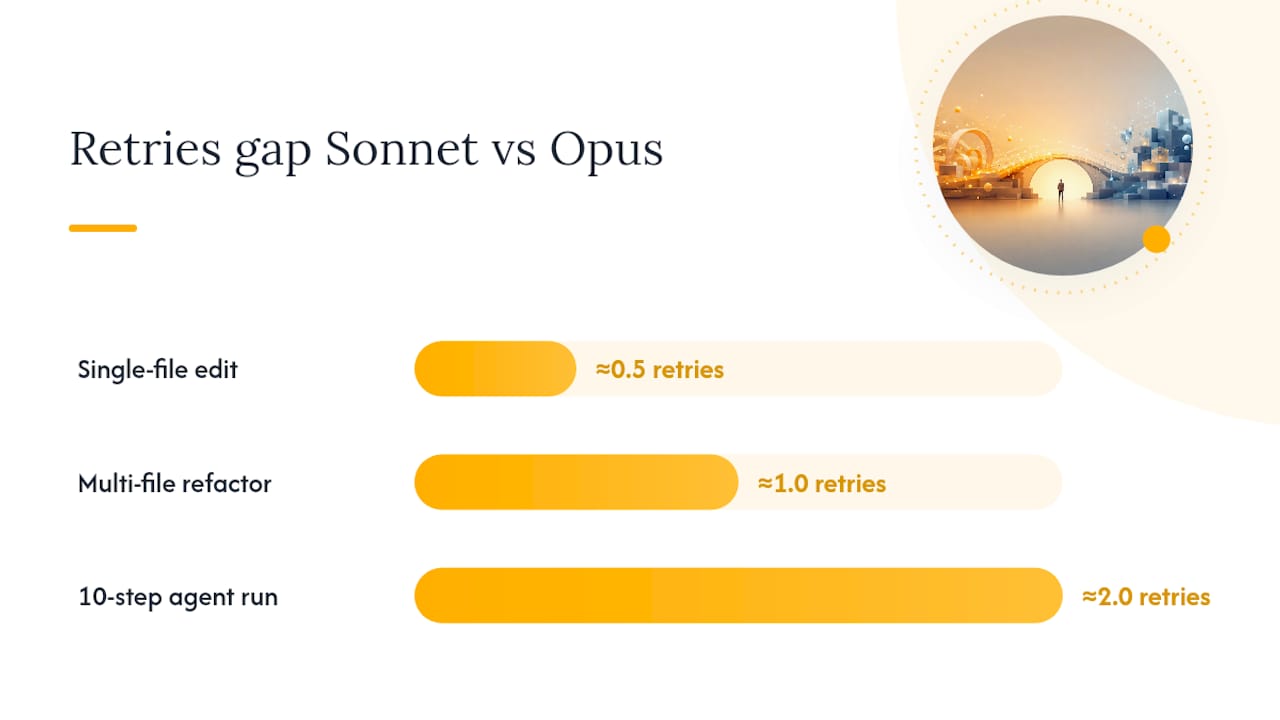
The pattern is consistent: on short, well-scoped tasks, Sonnet 5 matches Opus 5 in correctness and costs far less. On multi-step agent runs, Opus 5’s per-step reliability compounds. Two or three fewer retries across a 10-step agent run can flip the cost-per-completed-task math in Opus’s favor even at its higher sticker price.
SparkAgents’ benchmark analysis shows Sonnet 4.6 closed the gap on many coding benchmarks versus older Opus models, and sometimes outperformed them on practical office tasks. That trend continued into the current generation: Sonnet 5 is not a “lesser” model for most coding work; it’s a different cost-reliability tradeoff.
Dimension-by-dimension: where each model actually wins
Coding and agentic capability
Single-file edits: Sonnet 5 handles these cleanly. The gap versus Opus 5 is minimal, and at 2.5x the price difference (during introductory pricing), Sonnet is the obvious call.
Multi-file refactors and long-horizon agent loops are where Opus 5 earns its cost. Respan’s production findings confirm Opus is worth the premium for long-horizon agent runs where per-step reliability compounds. A Sonnet agent that drifts on step 7 of 12 costs you the entire run. Opus’s lower drift rate means fewer lost-agent loops, which matters more than the per-token price when you’re running autonomous pipelines.
Content work and creative writing
Opus 5 tends toward more nuanced, stylistically varied output on open-ended creative tasks. Sonnet 5 follows instructions tightly and produces clean, consistent prose. For content production at volume, Sonnet 5 is the better fit. For a single high-stakes deliverable where style depth matters, Opus 5 has an edge.
Token efficiency and output verbosity
Opus 5 can be more verbose on complex tasks, which affects cost-per-task even before retries enter the picture. Sonnet 5’s output tends to be more concise on structured tasks. Combined with its lower per-token rate, Sonnet 5’s effective cost advantage on short-to-medium tasks is wider than the sticker price ratio alone suggests.
Latency and fast mode
Both models support fast mode. For latency-sensitive UX (real-time chat, autocomplete, interactive coding assistants), Sonnet 5 in fast mode is the default choice. Opus 5 in fast mode is faster than Opus 5 at full effort, but still slower than Sonnet 5 at comparable settings.
Recency and knowledge cutoff
Both Opus 5 and Sonnet 5 share an early 2025 knowledge cutoff, which narrows the recency gap that existed between older Opus and Sonnet generations. For tasks that depend on post-cutoff information, retrieval-augmented generation (RAG) is the right lever regardless of which model you use.
Pro Tip: If you’re routing tasks based on recency needs, check whether a retrieval layer solves the problem before upgrading to a higher-tier model. RAG is cheaper than Opus.
Workload-to-model matrix
| Workload | Recommended Model | Reason |
|---|---|---|
| High-volume classification | Sonnet 5 | Cost-effective, equivalent accuracy |
| Retrieval-backed chat | Sonnet 5 | Low latency, sufficient reasoning |
| Single-file code edits | Sonnet 5 | Minimal quality gap, major cost savings |
| Multi-file refactor (agent loop) | Opus 5 | Cross-file dependency tracking, lower drift |
| Long-horizon autonomous agent (10+ steps) | Opus 5 | Per-step reliability compounds |
| Vision-heavy workflows | Opus 5 | More reliable multi-modal context handling |
| Security audit / highest-stakes reasoning | Opus 5 | Reduced retry rate on complex logic |
| Batch document processing | Sonnet 5 + Batch API | Async pricing, sufficient accuracy |
| Latency-sensitive UX | Sonnet 5 (fast mode) | Fastest response at acceptable quality |
| Maximum reasoning depth | Claude Fable 5 | When Opus 5 still isn’t enough |
What does Claude Opus actually cost per task?
Sticker price per million tokens tells you almost nothing useful. What matters is cost-per-completed-task, which folds in output verbosity, retry rate, and whether you’re using batch or synchronous API calls.
Pricing reference
Worked cost examples
-
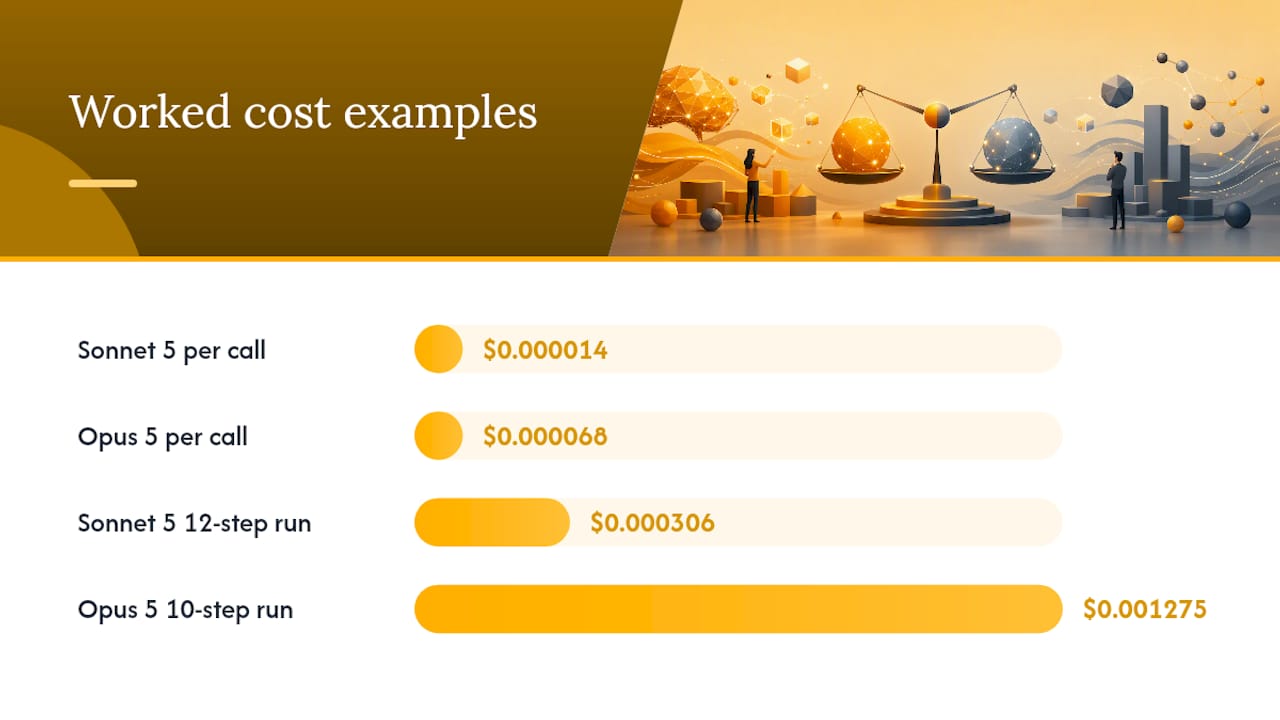
Single API code edit (500 input tokens, 800 output tokens):
- Sonnet 5 (intro): (500 × $0.000003) + (800 × $0.000015) = $0.0000015 + $0.000012 = ~$0.000014 per call
- Opus 5: (500 × $0.000015) + (800 × $0.000075) = $0.0000075 + $0.00006 = ~$0.000068 per call
- Opus costs roughly 5x more per call on this task.
-
10-step agent run (avg 1,000 input + 1,500 output tokens per step):
- Sonnet 5 (intro, 2 retries = 12 effective steps): 12 × [(1,000 × $0.000003) + (1,500 × $0.000015)] = 12 × $0.0000255 = ~$0.000306
- Opus 5 (0 retries = 10 steps): 10 × [(1,000 × $0.000015) + (1,500 × $0.000075)] = 10 × $0.0001275 = ~$0.001275
- Even with retries, Sonnet 5 is cheaper here. But at 4–5 retries, the math shifts.
-
Break-even retry rate: If Sonnet 5 requires more than roughly 4 retries per agent run to match Opus 5’s zero-retry completion, Opus 5 becomes cost-competitive on that workload.
Budget note: Sonnet 5’s introductory pricing makes it 2.5x cheaper than Opus 5 through August 31, 2026. Projects running into Q4 2026 should model costs at the standard rate, not the introductory one.
Prompt caching and Batch API are the two levers that reduce Opus 5’s effective cost on large async workloads. Run cost projections with both enabled before deciding Opus is out of budget. The batch discount alone can close a significant portion of the gap on high-volume, non-latency-sensitive tasks.
Which model should you use for your specific workload?
Short routing rules your team can follow:
- Default to Sonnet 5 for any task under 5 sequential steps, any classification or extraction job, any retrieval-backed chat, and any latency-sensitive interface.
- Escalate to Opus 5 when an agent run exceeds 10 steps, when cross-file dependency tracking is required, or when the task involves vision-heavy inputs and multi-modal reasoning.
- Use Claude Fable 5 only when Opus 5 is measurably failing on your benchmark and you need maximum reasoning depth. Its pricing is not publicly listed, so get a quote before building a pipeline around it.
- Try effort tuning first. Raising Sonnet 5’s effort parameter to high often closes the gap on demanding tasks before you need to switch models.
Decision checks for your team runbook:
- Does the task complete in under 5 steps with no cross-file dependencies? → Sonnet 5.
- Does the agent run drift or retry more than 3 times on Sonnet 5 at high effort? → Opus 5.
- Is latency under 2 seconds a hard requirement? → Sonnet 5 fast mode.
- Is the workload async and non-latency-sensitive at high volume? → Sonnet 5 + Batch API.
- Does the task involve vision inputs and multi-step reasoning? → Opus 5.
- Is this a security audit or highest-stakes reasoning task? → Opus 5, with human review.
For composite pipelines, route by task type within the same workflow. A document-processing pipeline might use Sonnet 5 for extraction and classification steps, then escalate to Opus 5 only for the final synthesis or reasoning step. That hybrid approach often cuts total pipeline cost by 40–60% versus running Opus 5 end-to-end.
How to evaluate and tune before you commit to a model
Side-by-side evaluation checklist
- Write a single prompt shell that works for both models. Keep system prompt, user message, and temperature identical.
- Run each model 10–20 times on representative inputs from your actual workload, not toy examples.
- Log
usagefields from every API response: input tokens, output tokens, cache hits, and latency. - Record retries: how many calls failed your correctness check and required a re-prompt?
- Compute cost-per-completed-task using the retry-adjusted call count, not the per-call sticker price.
- Score correctness with your test suite or a human reviewer. Binary pass/fail per output is enough to start.
Tuning checklist
- Effort parameter first. Set effort to
highon Sonnet 5 before considering Opus 5. Anthropic’s platform docs explicitly recommend tuning effort before switching model tiers. - Retrieval-first pattern. If the task depends on recent or domain-specific knowledge, add a retrieval layer before escalating to a higher-tier model.
- Prompt caching. Enable caching on long system prompts and repeated context blocks. This reduces effective input cost on both models.
- Fast mode trials. Test fast mode on latency-sensitive tasks. The quality drop is often smaller than expected on well-scoped prompts.
- Routing thresholds. Set a retry-rate threshold (e.g., more than 2 retries per 10 runs) as the trigger to escalate from Sonnet 5 to Opus 5 for a given task type.
Operational routing guidance
Build a routing layer that checks task type before sending to the API. Classify incoming tasks as short-form, long-form, or agentic, then map each class to a model and effort level. Log model ID alongside every API call so you can audit which tasks are hitting which model in production.
Pro Tip: Don’t A/B test models on your live traffic first. Run the evaluation offline on a logged sample of real requests, score correctness, then set routing rules before touching production.
Safety, guardrails, and security-sensitive workflows
Sonnet 5 vs Opus 5 on safety posture
Anthropic’s Sonnet 5 announcement documents an improved safety posture for Sonnet 5 compared with earlier Sonnet versions, including stronger safeguards on agentic tasks. Sonnet 5’s lower cyber capability rating relative to Opus 5 is actually an advantage in security-sensitive pipelines: it’s less likely to generate exploitable dynamic code without explicit instruction.
SonarSource’s analysis of Opus 4.5 and 4.6 found that Opus models can be “over-eager” on dynamic code generation, producing outputs that introduce security-sensitive patterns in some tests. Sonnet 4.6 produced more conservative, modular code in comparable prompts. That behavioral difference carries forward as a design consideration for security-critical pipelines.
Security note: For workflows that generate code executed in production, Sonnet 5’s more conservative output behavior reduces the surface area for unintended dynamic code execution. Opus 5’s higher capability is a liability, not an asset, in this context unless you have schema validation and test-suite gates on every output.
Practical controls for both models
- Schema validation: Run every model output through a schema check before execution, regardless of which model generated it.
- Test suites on generated code: Never execute Opus-generated code without a passing test suite. The over-eager behavior documented in Opus 4.x generations is a known risk pattern.
- Human review gates: For security audits, legal analysis, or any output that affects production infrastructure, require human sign-off before acting on the model’s output.
- Restricted tool access: In agentic pipelines, give the model only the tools it needs for the current step. Don’t expose filesystem write access to a model doing a read-only analysis task.
- Verification programs: If you’re using Opus 5 for cyber-relevant tasks, check Anthropic’s responsible scaling policy and enroll in any available verification programs before deployment.
Pro Tip: Treat model outputs as untrusted user input. Validate, sanitize, and test before execution — the same way you’d handle input from an external API.
Reproducible prompt and evaluation checklist
Prompt examples
Coding task (single-file edit):
System: You are a senior Python engineer. Respond only with the modified file. Do not explain changes.
User: Refactor the function `parse_config` in the file below to handle missing keys gracefully. Return None for missing optional keys and raise ValueError for missing required keys.
[FILE CONTENT HERE]
Multi-step agentic task:
System: You are an autonomous coding agent. You have access to read_file, write_file, and run_tests tools. Complete the task in the fewest steps possible. Stop when all tests pass.
User: Refactor the authentication module across files auth.py, middleware.py, and routes.py to use JWT tokens instead of session cookies. All existing tests must pass after the refactor.
Evaluation principle: A prompt that works on one model without modification is a better test of model capability than a prompt tuned specifically for one model. Write your eval prompts to be model-agnostic, then run them unchanged on both Sonnet 5 and Opus 5.
Evaluation checklist
- Log
input_tokens,output_tokens, andcache_read_input_tokensfrom every API response’susagefield. - Record wall-clock latency per call and total latency per completed task (including retries).
- Score each output: pass/fail against your test suite, or a 1–3 rubric if test suites aren’t available.
- Compute retry rate: (total calls / completed tasks) minus 1.
- Compute cost-per-completed-task: (total tokens across all calls including retries) × per-token rate.
- Run at least 20 samples per model per task type for statistical stability.
- Compare on representative inputs from your actual workload. Benchmark datasets are useful for orientation, but your production data is the ground truth.
Tool references: Use the Anthropic API’s usage object directly. For batch runs, the Batch API returns usage per request in the results file. Log model ID, effort level, and timestamp alongside every result so you can slice the data later.
Pro Tip: Store your eval results in a simple CSV: timestamp, model_id, effort_level, input_tokens, output_tokens, retries, pass_fail, cost. That log becomes your routing decision record and your budget forecast input.
What’s the final call on Sonnet vs Opus?
Sonnet 5 is the default. It handles the majority of production workloads at a fraction of Opus 5’s cost, and its quality gap versus Opus 5 on short-to-medium tasks is smaller than the price gap. The introductory pricing through August 31, 2026 makes the cost advantage even wider right now.
Escalate to Opus 5 for:
- Long-horizon agentic runs where per-step reliability compounds across 10+ steps
- Vision-heavy workflows requiring sustained multi-modal reasoning
- Security audits and highest-stakes reasoning tasks where retry cost and error risk outweigh per-token savings
Two next steps to implement now:
- Run a quick A/B test. Take 20 representative prompts from your current workload, run them on both Sonnet 5 and Opus 5 with identical settings, log tokens and retries, and compute cost-per-completed-task. The data will tell you where the break-even point is for your specific use case.
- Build a routing layer. Classify tasks by type and step count, set retry-rate thresholds as escalation triggers, and route by task rather than running everything on one model. Most pipelines can cut total model spend significantly without touching output quality.
What I’d tell you after running both in production
The model-switching instinct is almost always premature. Every time a pipeline underperforms on Sonnet, the first fix should be effort tuning and prompt tightening, not a model upgrade. The cases where Opus 5 genuinely earned its cost in my testing were long-horizon agent runs and multi-file refactors where cross-file dependency tracking broke down on Sonnet at any effort level.
The retry overhead is the part most teams underestimate. A Sonnet pipeline with a 30% retry rate on a complex task isn’t cheaper than Opus. It’s more expensive and slower. Measure retry rate before you conclude Sonnet is the cost-effective choice on a given workload. That number changes the math entirely.
Get consistent results across both models with Saimonsays
You’ve got the comparison. Now the gap between knowing which model to use and actually getting consistent output from it comes down to how you write the prompt.
Saimonsays is built for exactly this: model-specific prompt techniques, a live prompt refinery that translates what you want into a prompt that works, and side-by-side testing support so you’re not guessing which phrasing lands better on Sonnet versus Opus. The prompt tools at Saimonsays are free to use. If you’re migrating a production pipeline or need a full workflow audit, paid consulting sessions cover everything from a single diagnostic to a complete business overhaul. Start with the free refinery, test your prompts on both models, and book a session when you’re ready to lock in a routing strategy that holds.
Sources
- Choosing a model — Claude platform docs
- Claude Opus 5 vs Sonnet 5: Which Tier Do You Actually Need? — Apidog
- Introducing Claude Sonnet 5 — Anthropic
- A comparison of Claude Opus 4.5 and 4.6 — SonarSource blog
- Claude Sonnet vs Opus: Which Model Should You Actually Use in 2026? — SparkAgents
- Claude Opus vs Sonnet (2026): Which Tier Should You Actually Use? — Respan